This week we investigated the assumptions we make, when we challenge these assumptions we learn what problems may arise and plan solutions. This is helpful when working with clients as you can stay one step ahead and have contingency plans.
Task 1 - Part 1 Challenge assumptions.
In the first task we looked at these riddles and the assumptions we make to find the solution.
Q1. Relatives - A doctor in London had a brother in Manchester, who was a lawyer - but the lawyer in Manchester did not have a brother in London who was a doctor. Why?
it's his sister ... this was easy, a childhood joke
Q2. Bottled Money - If you put a small coin piece in an empty bottle and replaced the cork, how would you get the coin out of the bottle without taking out the cork or breaking the bottle?
push the cork in - this was a little more difficult, the class could not resolve it, but once you know, it seems so obvious
Q3. The Restaurant Meal - Three women each have two daughters, and they all go into a restaurant for a meal. There are only seven vacant seats in the restaurant, but each has a seat for herself. How do they manage it?
"It's a grandmother daughter thing" was the answer, and yes Paul was correct!
Task 2 - Part 2 Challenge assumptions
MIKE’S AUDITION
Have you ever been in Los Angeles freeway traffic? We were once in bumper‐to‐bumper traffic, trying to get to the airport at 10:30 at night. I didn't know that there were traffic jams until late in the evening. In any case, if you have had a similar experience, you can relate to the following problem, which will show us how challenging assumptions leads to more creative solutions.
Mike had an audition for a movie role at eight the next morning. But it was in Hollywood, and he lived on the other side of Los Angeles. He was notified of the audition late, and now it was one in the morning. This was a problem, because it could take as much as four hours to get through the morning traffic, and he needed time to shower and get ready. He would have to get up by a little after three that morning.
He thought about this. Just two hours of sleep, followed by hours on the freeway ‐ this might affect his performance. This would be his first important role if he was hired, so his mind started scrambling for solutions. Taking the bus might be faster than driving his van, but he didn't know the bus schedules, and it was too late to find out. He looked at a map of the city, hoping for a better route, and he might have found one, but it seemed dangerous to guess about routes he wasn't familiar with at this point.
He suddenly recalled a problem solving technique his friend Steve had told him about, and decided to try it. He did the assumption‐challenging exercise, starting with a pen and piece of paper and writing a list of assumptions.
1. What would be on your list of assumptions ‐ if you were Mike?
Assuming:
- the traffic will be busy at 3 in the morning.
- it will take 4 hours to get to the other side of the city.
- that buses will be infrequent, that he will need a timetable.
- he could take the bus.
- he has to drive to the other side of town.
- he needs to sleep 2 hours.
- he wants the acting job.
- he needs to shower and take time to get ready.
- a bus might be faster.
- the interview time could not be changed.
- there is no other form of transport.
- I have to leave at 3 in the morning.
2. Challenge each item in the list and find a solution to Mike’s problem
Drive at 1 in the morning and sleep in your car, shower when you're there.
He could get a helicopter of sub-way.
Because he is leaving so early the traffic might be minimal and it will not take 4 hours. - leaving things to chance
The buses might leave every 15 minutes and take less travel time in bus lanes. - possible but might not work
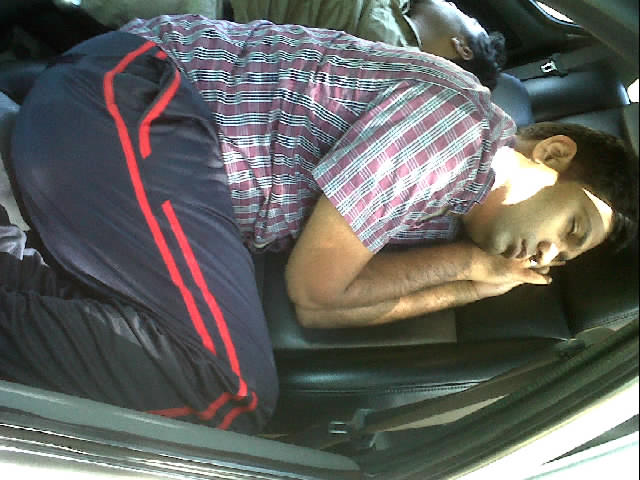 |
| Maybe Mike doesn't wake up from his sleep in the car |
 |
| Maybe it's inconsequential if Mike goes to the interview or not. |
The assumption can be obvious and when we challenge them, we can find the solution.
You can use this method when designing, list all the assumptions and find solutions. For example, we expect the elastic for the helmet cover to be available but if we investigate early we can ensure it is or build in a waiting period, this will help the work process to flow smoothly.
Another example of reviewing assumptions and challenging them is when you get a printing job, check with the printer how much time they need to print, double this time to leave contingency for errors.
Task 3 - Design Challenge / reflect & refine
I choose to reflect and refine the Web page we are developing for the helmet cover for exhibition.
Assumptions about the design of web page.
- People will be interested in watching video.
- We have information to navigate to.
Challenge the assumptions:
- People might think the video is boring and switch off, they might not understand it is promoting a helmet cover. They might think the video makes the helmet cover look like a product they don't want to buy. They might choose not to watch the video. One video may not get the complete message across.
- We might not have enough information to fill a page. The information might be so stretched and repetitive it becomes boring. We don't need to just talk about the helmet covers we have made. Repetition can be good, gets the message across.
Refinements:
- When you make a video show a group in class and monitor their reactions, ask them their opinion; was it interesting? Did they want to turn it off? What message did they get from the video? Was the product clearly displayed? Were they convinced that they might want to buy or recommend the product?
- Depending on what information we have we might need to combine navigation buttons so we don't end up with empty pages or pages that look like we have nothing to say. We could also add designs we have not made up. We could add information about ourselves, the designers and the design process..
Research
One challenge we thought we would have is printing onto the material we chose, a Nylon/Spandex mix. When we initially called the printing company they said they had had problems in the past printing on the nylon/ spandex material we chose, the high heats sometimes ruin the material. With this in mind we took a sample of the material to the printers to test, this would determine our future design constraints.
Luckily, both the Digitex and Digital Vapour Infusion methods worked well. The DVI colours vary from what is in illustrator, so in the design process I would say that your colour choice will have to be approximate rather than an exact match.
 |
| original image for print |
 |
| Digitex on the left and DVI on the right |
You can also see the flares did not work, however they might be able to do this in the final print.


